

Editor's Postlude: What Is United Church Worship?
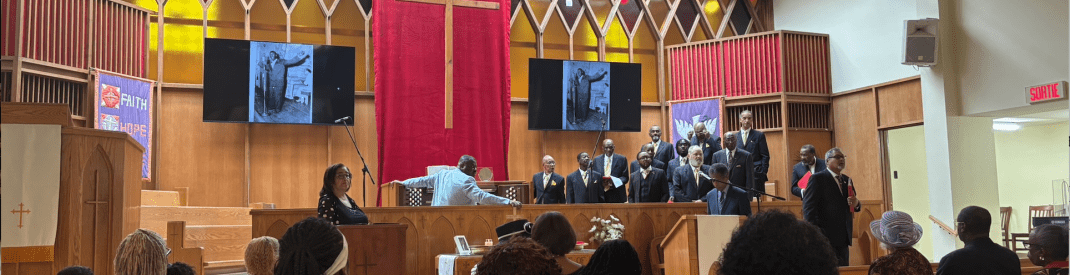
What makes a worship service a United Church worship service? It is a question that we often discuss at Gathering Advisory Board meetings but have never been able to fully answer. This summer, my partner and I were in Montreal and wanted to attend Sunday worship. As it happened, our accommodation was just a few blocks from Union United, a congregation with a long and important history. A group of Black railway porters and their wives decided that they wanted to worship in their own church in their own style. The dignity, equality, and full participation of all, regardless of gender, ethnic origin, or faith background were their core tenets. The first service as Union Congregational Church was held on September 1, 1907, with 26 people in attendance. Central to the congregation through its history has been the participation of women in all leadership roles, social justice, and providing for the needs of the community. Music is at the heart of Union United. This is where jazz legend Oscar Peterson first took piano lessons and was a member. Another well-known jazz pianist, Oliver Jones, is also a member, and even at age 91 plays occasionally during worship.
After the service, the lay worship leaders who had presided that Sunday chatted with us. Upon learning that we were both ordained clergy and that I was the editor of Gathering, a magazine used by the congregation, one asked, “Did you feel like you were in a United Church during the service?”
Our answer was a definite yes! Yes, we felt we were in a United Church. Yes, it felt like United Church worship. But it also had its own style, rooted in Black culture and music. So, what made it feel United Church?
There was a land acknowledgement. The liturgical approach was more casual than formal. The flow of liturgy allowed for people to be themselves, raising hands in praise, standing or sitting as needed, using a fan (with the Lord’s Prayer printed on it) to keep cool on a warm day. The language was inclusive. Voices United hymn books were in the pews. Music was essential to the service and most hymns and service music were familiar. Coffee and tea were served after worship. People delighted in catching up with each other as they arrived in the sanctuary. A warm welcome was given to visitors. Announcements preceded the service.
But do these things make it United Church worship? I’ve worshipped in churches of other denominations where I was warmly welcomed, worship had a similar flow, music was central, and coffee and tea were served after worship. So, what is it that makes United Church worship United Church worship? What I do know is that when I worship in a United Church congregation, whether in Halifax, Montreal, Vancouver, Camrose, Yorkton, Corner Brook, or Kenora, I know that I am in a United Church. Perhaps our readers from other denominations can answer the question better than I.
It was made clear during the formation of the United Church that the uniting congregations were free to continue to worship in the style of their founding denominations and that each congregation should follow the leading of the Spirit in adapting provided prayers and liturgies to their context and congregation. There would be no prescribed liturgies. “Ordered liberty,” not uniformity, was the phrase used to describe the worship practices of the new union of churches.
Perhaps, this is what makes United Church worship United Church worship: ordered liberty. I believe that what is essential is that United Church worship reflects the cultures and context of those worshipping. In this way, worship is genuine and authentic, coming from the heart of the congregation. That is what we experienced at Union United and that is what I love experiencing in whatever United Church I attend.
I invite you to take time to consider how your worship service comes from the heart of the context and cultures of your congregation. What is the ordered liberty that shapes your worship as you respond to the wise, dancing Spirit who guides you in worship planning?
Susan Lukey, Editor